



近日,在美国芝加哥举行的美国化学会秋季年会上,樊新元教授被正式授予“2026年美国化学会Bioconjugate Chemistry青年科学家奖”。该奖项由美国化学会旗下权威期刊《Bioconjugate Chemistry》主办、联合美国化学会生物化学与化学生物学分会共同组织,每年在全球范围内遴选1位青年学者。樊新元教授作为本年度唯一获奖者受邀参会,并作了题为“Bioorthogonal Photocatalytic Proximity Labeling for Spatiotemporal Proteomics and Beyond”的获奖特邀报告。该荣誉的获得,体现了国际学术界对色情直播 在化学生物学与生物正交光催化等前沿交叉领域学术创新的高度认可。
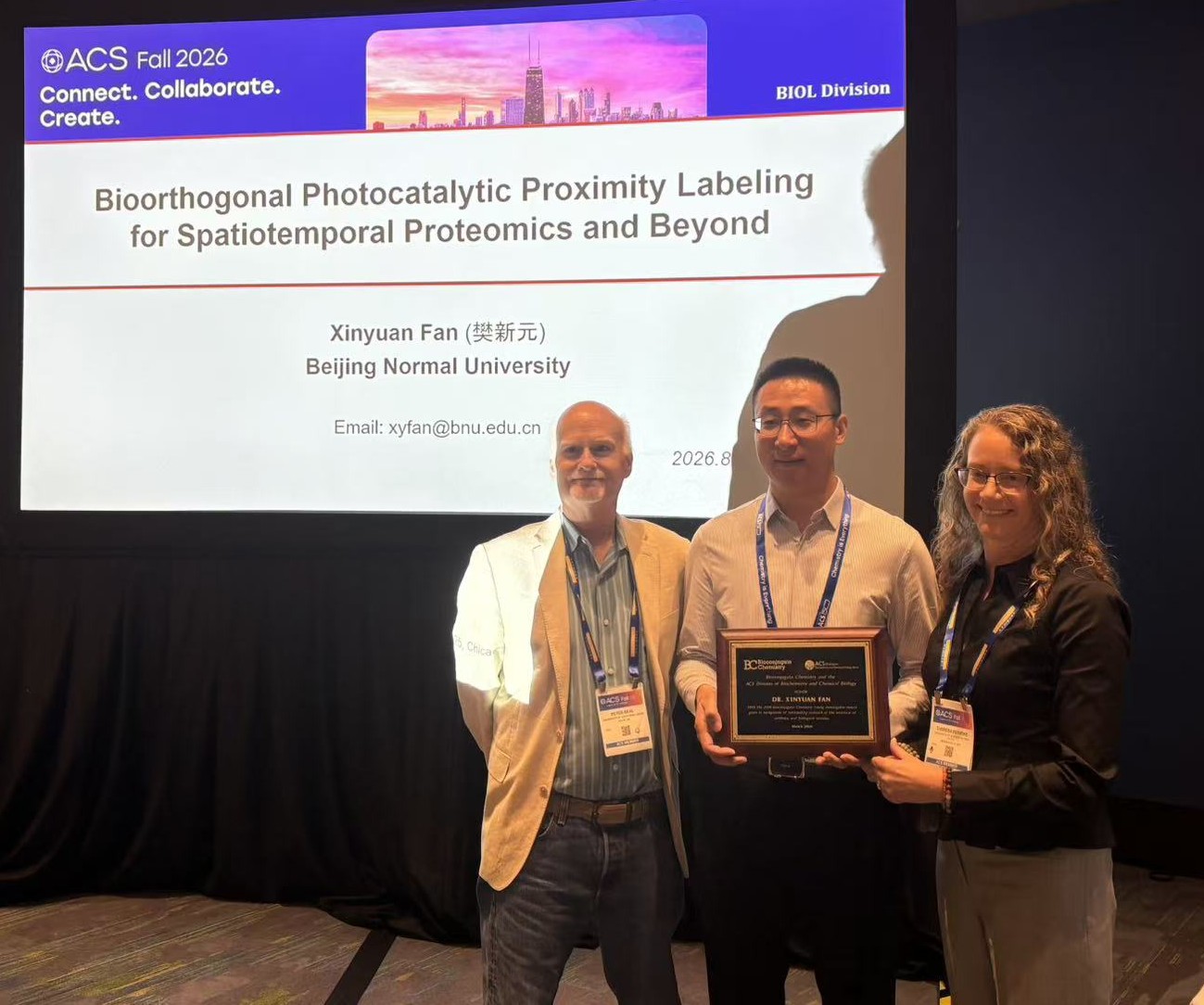
图:《Bioconjugate Chemistry》主编 Theresa M. Reineke 教授 (右一) 等宣读颁奖词并为樊新元教授颁发奖牌
樊新元教授团队长期致力于化学生物学、生物正交化学与时空分辨多组学的前沿交叉研究。针对复杂生命体系中蛋白质原位时空解析难题,团队系统发展了“生物正交光催化”新策略,将生物正交化学的高生物相容性与光催化的高效时空可控性深度融合。以此为核心,团队自主构建了CAT-X生物正交光催化技术平台(涵盖CAT-S、CAT-seq、CAT-Lyso等13项特色技术),实现了原代细胞与临床组织样本中的亚细胞多组学标记、跨尺度互作解析以及可控分子激活。该系列工作有效克服了传统遗传学与酶学方法在难转染生物样本中的局限,为解析疾病发生发展的分子机制和发展精准化学干预手段提供了实用的新工具,也为推动色情直播 化学生物学交叉学科的高质量发展注入了新动能。
【奖项简介】
“美国化学会 Bioconjugate Chemistry 青年科学家奖”设立于2016年,并于2023年正式更名为青年科学家奖,旨在表彰全球范围内在合成化学与生命科学交叉领域作出重要突破与贡献的优秀青年学者。奖项由国际权威专家组成的遴选委员会严格评审产生,每年在全球仅遴选1位获奖者。改设为青年科学家奖以来的历届获奖人包括:瑞士苏黎世联邦理工学院 Jean-Christophe Leroux 教授 (2023年)、美国波士顿学院 Abhishek Chatterjee 教授 (2024年) 以及美国莱斯大学 Han Xiao 教授 (2025年) 等国际知名学者。
【颁奖词摘录】
《Bioconjugate Chemistry》主编 Theresa M. Reineke 教授在现场宣读的颁奖词中对樊新元教授的工作给予了高度评价: “樊新元博士工作的核心标志是发展了生物正交光催化,这一创新策略将生物正交化学的生物相容性与光催化反应的时空精准性有机结合,为在天然生命微环境中操纵和探测分子事件开辟了全新可能。在此基础上,樊博士团队建立的 CAT-X 技术平台,实现了非基因依赖、光控的高分辨率邻近标记,成功将蛋白质组学研究拓展至传统酶学方法难以涉足的复杂生物样本体系。该工作的原创性与深远影响生动诠释了青年科学家奖的精神,彰显了化学创新在深化生命系统理解及最终赋能疾病诊疗新方法中的变革性力量。”
(附英文原文: "A hallmark of Dr. Fan’s work has been the development of bioorthogonal photocatalysis, an innovative strategy that combines the biocompatibility of bioorthogonal chemistry with the spatial and temporal precision of photocatalytic reactions. This conceptual advance has created new opportunities to investigate biological processes in their native contexts, enabling researchers to manipulate and interrogate molecular events with exceptional spatial and temporal control.
Building on this foundation, Dr. Fan and his colleagues developed the CAT-X technology platform, a suite of photocatalytic tools that enables non-genetic, light-controlled proximity labeling across a range of cellular and intercellular scales. These technologies are opening powerful new avenues for mapping local proteomes, studying dynamic multi-omics networks, and extending proteomic investigations into complex biological samples that have traditionally been difficult to access using enzyme-based methods.
The creativity and impact of this work exemplify the spirit of the Bioconjugate Chemistry Young Investigator Award, demonstrating how advances in chemistry can transform our ability to understand biological systems and ultimately enable new approaches to studying health and disease.")
友情链接